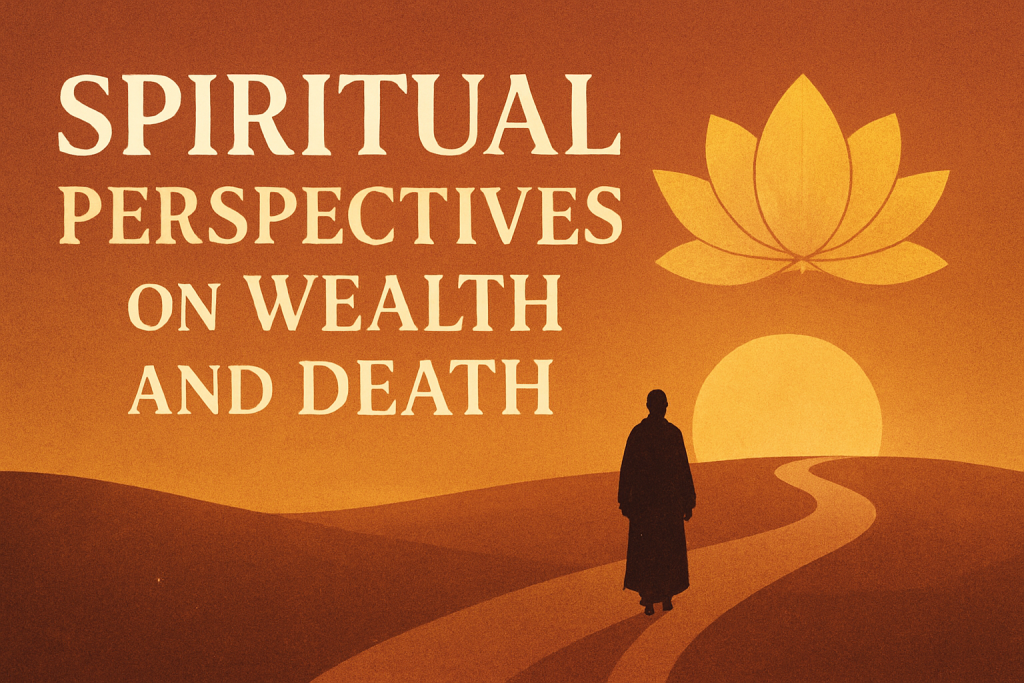
Spiritual Perspectives on Wealth and Death
Introduction: Two Mysteries That Shape Our Lives
“One teaches us to build, the other teaches us to let go. Together, wealth and death shape the rhythm of human life.”
Humanity has always wrestled with two great forces – the pursuit of wealth and the certainty of death.
One represents creation, accumulation, and building; the other represents dissolution, surrender, and the return to the infinite.
Across cultures and centuries, sages and seekers have asked:
- What does it mean to live a wealthy life?
- What does it mean to die well?
- And is there a way to hold both truths without fear?
This exploration takes you through spiritual wisdom, ancient texts, and practical insights to help you reimagine both wealth and death – not as enemies, but as teachers.
The Nature of Wealth: Beyond Coins and Currency
“True wealth is harmony – of prosperity, wisdom, purpose, and peace.”
Visual Idea:
Infographic: “The Four Dimensions of Wealth” – a circular diagram with:
- Material Wealth (money, possessions)
- Relational Wealth (family, community, reputation)
- Wisdom Wealth (knowledge, life lessons)
- Spiritual Wealth (inner peace, purpose)
Wealth in Hindu Thought
The goddess Lakshmi symbolizes abundance – not only of money but of knowledge, fertility, courage, and harmony.
In the Vedic view, being “wealthy” is living in balance with:
- Dhana – material prosperity
- Vidya – wisdom
- Dharma – righteous living
- Shanti – peace
Wealth in Buddhism
The Buddha warned against attachment, not against wealth itself.
Right livelihood (samma ajiva) teaches that wealth earned ethically can support a meaningful, compassionate life.
Wealth in Stoic Thought
Stoics saw wealth as a “preferred indifferent” – useful if it serves virtue, irrelevant if it corrupts.
Across traditions, wealth is seen not as the destination but as a means to grow the soul.
Death: The Great Teacher
“Remembering death is not a curse – it is the permission to live fully.”
Visual Idea:
Illustration: A serene sunset with a faint silhouette walking a path – symbolizing transition, not end.
Hindu View
The Bhagavad Gita reminds us:
“For the soul, there is neither birth nor death. It has not come into being, does not come into being, and will not come into being.”
Death is a passage, not a punishment.
Buddhist View
Maranasati – mindfulness of death – is a meditation practice to deepen gratitude and reduce attachment.
Western Philosophers
Socrates called philosophy “the practice of dying,” urging us to live in a way that leaves the soul light.
Wealth and Death in Dialogue
“Death reminds us that no possession is permanent. Wealth reminds us that life is precious enough to steward well.”
These two realities are not opposites. They complement each other:
- Wealth teaches us to care, to build, to preserve.
- Death teaches us to release, to trust, to surrender.
When held together, they create a life of balance – responsibility without obsession, freedom without neglect.
The Trap of Clinging
“Clinging to wealth is the attempt to buy immortality.”
The Upanishads teach that desire creates fear and grief.
Clinging to wealth in hopes of avoiding death only deepens suffering.
The solution is not rejection of wealth, but detachment – using wealth without becoming possessed by it.
Cultivating Spiritual Wealth While Alive
“If nothing material follows us, then spiritual wealth must be our greatest inheritance.”
Visual Idea:
Infographic: “The Three Treasures We Carry Beyond Death” –
- Karma (our actions)
- Wisdom (our lessons)
- Compassion (our love)
Practices to Grow Spiritual Wealth:
- Mindful Earning: Choose work that aligns with ethics and values.
- Conscious Giving: Charity or service, even small, strengthens abundance mindset.
- Simplicity: Find joy in fewer possessions – minimalism as a spiritual practice.
- Death Awareness Practice: A daily reminder of impermanence sharpens gratitude.
- Legacy Thinking: Ask what impact, not just wealth, you are leaving behind.
The Art of Dying Well
“A good death is a peaceful release – the soul unburdened by regret or unfinished duty.”
Spiritual traditions say that dying well is the result of living well – with honesty, compassion, and courage.
When we have done what we must, given what we can, and made peace with life, death ceases to feel like a thief.
Conclusion: The Meeting Point of Two Teachers
“Perhaps the highest wealth is the ability to face death without fear.”
Wealth teaches discipline, generosity, and responsibility.
Death teaches humility, impermanence, and surrender.
To hold them together is to live a life that is full yet light, engaged yet unattached.
Perhaps that is the ultimate spiritual achievement:
to have enough to live meaningfully –
and the wisdom to let go when the time comes.